


Customer Applications of TESIS Simulation Software
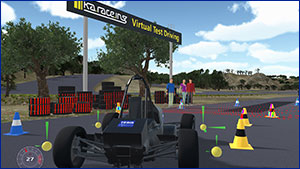
Formula Student Driverless
KA-RaceIng's sucessful Driverless team uses simulation with DYNA4 and ROS for validation of their autonomous system.

Valet Parking
Virtual vehicle, sensors and parking garages for development of automated parking functions on the PC or HiL system.
AL-KO: Automated testing of trailer stabilization
Far-reaching improvements to AL-KO trailer stabilization with simulation-based investigations of trailer variants.
TU Munich: System Simulation in DYNA4 based on ADAMS Data
Simulation based development of the Visio.M battery electric vehicle with automated usage of Adams axle data.
Platform for interdisciplinary vehicle simulation
Together with the University of Munich (TUM), TESIS has launched the sim2gether research and development project.
Audi: Energy management for the vehicle fleet
Efficient energy management for the Audi vehicle fleet is a cross-department challenge. The DYNA4 simulation framework is the suitable solution.
Bombardier electric city bus: validation through simulation
Simulation-based testing of the interaction between the vehicle dynamics and the electric propulsion system in extreme conditions.
Magna Powertrain: Frontloading for 4WD systems
The traction control systems at Magna Powertrain are developed in close cooperation of simulation and the road tests.
Iveco: Simulation of multi-axle trucks for diverse ESP tests
Iveco: DYNA4 simulation models for multi-axle trucks in use for automated ESC testing.
ARAI: HiL simulation for semi-active suspension development
ARAI SAE paper: Simulation based design of a semi-active suspension for an optimum between ride comfort and road holding.
Audi: Analyses of signal errors on the complete vehicle
Audi analyzes the effect of faulty input signals on the complete vehicle in DYNA4 simulation environment.
UNAM Motorsports: Validation of control algorithms
UNAM Motorsports used veDYNA to simulate different maneuvers in order to validate the algorithms of the vehicle ECU.
Audi: Characteristic assessment of vehicle dynamics controls
The TESIS hardware-in-the-Loop systems (HiLs) allow the virtual assessment of vehicle dynamics characteristics for a wide range of variants.
Audi: Calculation of fuel consumption for driver display
To analyze fuel consumption measurements for the vehicle series, Audi relies on TESIS' engineering experience and simulation software.
Magna: A driver model for ECU development
TESIS' comprehensive driver model supports tests for the functional safeguarding and application of vehicle control systems.
Ford: Model-based testing of the lane keeping system
Ford uses model-based development to exclude error sources in an early development stage and reduces expensive prototype testing.
Audi: Managing Variant Diversity
TESIS and Audi have developed standardized process for simulation based ECU validation of a wide range of vehicle configurations.
GM: Thermodynamic engine models for Diesel ECUs
By using the enDYNA simulation software, GM is able to test even its new generation of engine control units with the required high resolution and accuracy.
ADAS testing of camera-based systems at BMW
Several controller functions, as lane detection, vehicle recognition or traffic sign recognition can be tested using the realistic concept of the simulation environment.
Test drives in a simulator at Regensburg UAS
Mechanical engineering students can now put their theoretical knowledge of vehicle dynamics into practice on a simulator.
Real driving pleasure: Audi test drives in a simulator
The realistic simulators allow drivers to experience the driving behaviors of different Audi models on several tracks under different weather conditions.
Knorr Bremse: MBS model integration into DYNA4
The MBS vehicle model can be used in DYNA4 comprehensively for ECU development - from MiL to HiL.
VW: Measurement-based driving dynamics simulation
VW uses K&C measurements to automatize the comparison of the driving dynamics of competitors and own vehicles.
Detail designs – vehicle dynamics development at Ford
Norbert Kessing, manager of vehicle dynamics, grants an insight, how Ford of Europe realizes its efficient vehicle dynamics development processes.
BMW: Simulation model of the active roll stabilization
BMW uses the real-time capable hydraulic model for simulations on the PC and on HiL systems for development and validation of control functions.
Knott: Virtual Validation of the trailer stabilization
Knott employs vehicle dynamics software for conception studies, function development and validation of its electronic trailer stabilization.
Magna: Development of the vehicle dynamics control
Magna Steyr reduces development time by controller development and pre-calibration with veDYNA.
TU Graz FSAE: Race car optimization with simulation
Support of the TU Graz Racing Team with vehicle dynamics simulation to defend their pole position.
ViF: Simulation of hybrid vehicles' cooling system
The Virtual Vehicle Competence Center (vif) simulated the thermal behavior of the electrical system in a hybrid SUV under different loads and ambient conditions.
Curtin FSAE: Vehicle dynamics simulation for the pole position
TESIS supports Formula Student teams with simulation software, e.g. the Australian Curtin-Team.
Ford: Virtual suspension development with K&C data
Ford uses the automated process in veDYNA to parametrize the suspension models from K&C measurements.
Ford: Simulation based engine development on a HiL system
Ford is analyzing and testing ECU functions for a new 3-cylinder engine on a HIL test bench with enDYNA.
CLAAS: Engine simulation in the harvester development
CLAAS reduces the development time by performing seasonal independent and reliable ECU function tests in a harvester simulation environment.
Bentley: HiL environment for test of connected ECUs
The comfortable selection of vehicle models on the centralized PC reduces the efforts for variant handling substantly.
MAN: Real-time 12 cylinder engine simulation
The physical engine model enDYNA Thermo provides the required model precision and was perfectly implemented on a fast HiL system.
Optimal engine calibration for individual driving styles
The University of Michigan determines with the engine simulation enDYNA the optimal injection timing for diesel engines.
BMW: Fuel economy simulation for the vehicle fleet
Simulation of the entire vehicle enables a precise prediction of the effectiveness of fuel economy measures.